
Teaching Conventions and Mechanics
Assessing Grammar
Assessments for grammar used in a classroom of English Language Arts (ELA) at the secondary level should, in my opinion, be mostly formative (FA), with fewer summative assessments (SA) so that students can be conceptually fed more than they are taxed with producing and so they are given as much practice time as possible in order to become more naturally attached to the notions that are offered in the area of learning we call grammar. This inclined determination does not come directly from one academic source or another, but rather it comes from personal experience and an incalculable host of reading that I have done on this topic over the last fifteen years as a professional in ELA (specializing in English as an Additional Language, or EAL). Whether it has been communication practice with Vietnamese high schoolers, afternoon Scrabble or Debate Club with mixed-ability/age students in China, or flashcard practice with kindergarteners in South Korea, I have witnessed the value of the personalized feedback that comes from informal settings provided by thoughtful FAs and how they do so well to inform future teaching. That feedback works as the fuel for proper future engagement. It allows a teacher to listen clearly to students as they grow through their organic progress, rather than pressuring them by tasking their abilities to score highly on tests such as the Cambridge and Oxford exams that the all-famous iGCSE provide or their American equivalents.
Indeed, to support the interpretive nature of recognizing and assessing grammar in the area of assessments, even the well-thought-through document provided in this C-369 course named “Teaching and Testing Grammar,” by Diane Larsen-Freeman (2009), offers wonderfully nebulous descriptions such as her first line: “Perhaps no term in the language teaching field is as ambiguous as grammar,” (emphasis, hers) and later on as she describes how “each one of [her] seven definitions is multidimensional” and because when assessing grammar, methods that are “decontextualized, discrete-point items such as …” where she lists a variety of imperfect, but certainly applicable, widely used methods – we teachers are not truly able to provide a single answer for how exactly to assess grammar (Larsen-Freeman 2009). Indeed, discrete methods are appropriate at many points of interaction for assessment, but to truly assess a student’s capacity, one needs to speak with them in informal ways, encouraging conversations that allow the students to utilize what has been studied, or to have them write at length so that a similarly incidental usage is achieved. Of course, there are standardized methods for this to provide for SA, as having a static record of achievement is a normal requirement for schooling. For example, a collection I’ve used by the well-known Oxford Publishing house named World Explorers is a good example, with its oral questionnaires and open-ended questions, allowing students to show what they’ve learned along with fill-in-the-blank questions that allow a student to show they understand how pronouns work, etc. (Oxford 2012).
To be sure, students who are preparing for American tests such as the SAT or ACT have a genuine need for practice around testing. To make this discrete skill accessible, it can be provided for them in low-stakes environments in a classroom with practice tests that can be effectively reviewed by students to help them understand where their areas that can be improved are. This method is an example of using FA to prepare for SA in a way that can give the experience to students of the SA, so they are not uncomfortable in the setting with it when the time comes to take one. In my classrooms, if given my druthers, I would use an SA a maximum of four times a course-structure, so that they are primed to be ready for the broader world, but as a result of the more frequent FAs they would experience a less stressful setting in my classroom by not being pressured to produce in the format more often than completely necessary.
Corresponding Methodology
There are hundreds or perhaps even thousands of appropriate teaching methods and innumerable topics to focus on as content due to the flexible nature of the English Language Arts. From student learning activities, multi-media applications, flipped classrooms, inquiry-based learning, problem-based learning, project-based learning and many, many more (Carter 2006, Chandrasekar 2016, Gardener 2024, Hall 2016, Hancock 1998, Jones 2021, Levin et al. 1999). Methodology is truly an array of possibilities to be approached as colors in a painter’s palate, as far as I’m concerned. Depending on the students, a different approach may be more fitting than another. Depending on the goals, the focus will shift. Am I engaged with working within an inquiry-based curriculum alongside a STEAM-heavy course load that includes Geology, Physics, and Pure Maths? Or is it a less progressive setting that has a curriculum based around focusing on testing, coming from a pre-proscribed set of information?
If given design flexibility, in order to teach students a holistic path of ELA growth at something like the ninth or tenth grade level, I would like to start with block scheduling, allowing for 90-minute segments of time together, so that I would be able to create a host of interactivity for them. Warmups could consist of reading or conversation and could last anywhere from five to fifteen minutes. From there, with the daily goals established, we would start in on the lesson of the day. Obviously, lessons will vary in style, depending on the goals and material at hand, may it be a literature review using something like a scene from Romeo and Juliet, or a section of a young adult novel of contemporary origin; a writing foray, something like how to write a letter to the editor, or writing in an unexplored genre; or historical contextualization of the language, for an etymological or grammatical lesson. However, no matter what the lesson of the day is about, there will be a point at which, I as a teacher, provide static input to work from. That input could be a video, a worksheet for them to read and work through, a research question for them to work with on the internet, or something else. From that starting point, I would step into a section of the class that could be called a controlled practice or challenge. In this section, there is a formulaic question that is presented to the students so they can put their minds to work around the input provided within an area of focus. From there, we would reflect on it either through group sharing, whole-class sharing, or something else that allows me to take in the input of a FA, to better step into the next section of our class. That next section would be a freer practice/challenge for them to more broadly take time putting effort around the overarching goal of the class. A resultant product or an exit slip that consists of a reflection on the day’s work would be valuable to help me know what students garnered from our experience and could help inform following lessons.
As we are in an era that offers the profound technology of what had come to be known as Artificial Intelligence (AI), I would hesitate from asking students to do homework that consists of broad-based writing. As such, I would use a substantial portion of the 90-minute block for most of their writing and research and then encourage them to only use home-time as a time to polish their class-time efforts.
By achieving a deeper understanding of the structure and mechanics of language, students will extend their proficiencies in many ways. For example, by understanding the skills of skimming and scanning to preview a text, a student can better approach a text by garnering the context and meaning of it through its structure and key points, observable through these techniques (Ontario n.d.). This applies to how they look at everything from literature to informative texts that may share knowledge about topics like sciences, history, and more. This is because when students are approaching different types of writing in thoughtfully more appropriate ways, they can have a richer experience with it. One does not approach a metaphorical, poetic soliloquy with the same method as one would look at a geological description of fossils found in Montana. Similarly, by having the skills of understanding how to create these disparate styles of writing, a student can represent their thoughts and goals better through using the appropriate methods of English composition.
Example in Practice
Summary~
Topic: Recognition of, and use of dependent clauses together with adjective-order
Language standard: CCSS 1.b. Demonstrate command of the conventions of standard English grammar and usage when writing or speaking.
a. Use parallel structure.
b. Use various types of phrases (noun, verb, adjectival, adverbial, participial, prepositional, absolute) and clauses (independent, dependent; noun, relative, adverbial) to convey specific meanings and add variety and interest to writing or presentations.
Objective: Given a photographic image of a busy scene, students will be able to describe what they see using complex sentences, including dependent clauses and appropriate adjective use 70% of the time.
Measurement: Students will be tasked with writing (or describing orally, depending on IEP parameters and recommendations) what they see in an image to the extent of choosing three nouns to describe from within it. Their narrative responses will be graded by noticing their language use with particular attention paid to their use of dependent clauses and descriptive adjectives.
Explanatory Description~
Given the goals as stated above in the summary, I have found that an overlay of short exemplar texts being used as exposure-units to start with, followed by inquiry around them is a good way to begin.
One way to do that is by using the grammar structure that is the goal of the lesson in a couple sentences, but with a third that does not show it. Asking the students what they see, asking them to compare the structures, then asking them if they know why the structures in focus are set as they are gets students into smart inquiry around the topic at hand, together with a bit of thoughtful guidance if needed, allows their natural curiosity to deconstruct the presented material to the point of isolating what it is that is isolated on the board in the examples.
For example: The topic of teaching how to spot (and later create) dependent clauses could have the three sentences that follow on the board.
“There are seventeen tomatoes on the plant, nine are still green.
There are twelve students in the class, each student has a hat on.
Fourteen cars are in the parking lot and six of them are running.”
By using these three sentences with students, noting how the second sentence has an independent clause as its secondary, students get exposure to how different structures work, can see them in practice, then can begin discussion in groups about how they might create more complex sentences of their own.
Another way to teach this grammatical notion would be to explicitly describe it. This would provide the necessary knowledge to language learners who are coming from other languages or individualized dialects of American, British, Saffa, etc. origin. Being that these dialects and non-native grammars are valid and logical in their own, a clear discussion of the logic is valuable to clarify the intended end result (Kennedy 1993, McLaren 2009).
The second grammatical element that would accompany this activity is the order of adjectives. Using the same design as above, examples such as those below would suffice.
“The tabby cat was a wonderfully furry and friendly creature.
Howard had a big, red dog with ears that are floppy and long.
At her home, Josie has a funny, red fish, big, slippery.”
Again, using intentional anomalies for discussion is an element, as can be seen in sentence three. This is a particularly helpful structure of focus for a class that has learners of English from origins that are not primarily English language because of how English functions differently than other languages. As such, having graphs that show how adjective-order works, available for students who need them such as the one pictured here (sourced in 2018, no longer visible on the host website), is useful to illustrate how English language functions (T.E.S. 2016). E.g., one would not typically say “a wool, beautiful, brown blanket,” but would rather say “a beautiful, brown, wool blanket.”
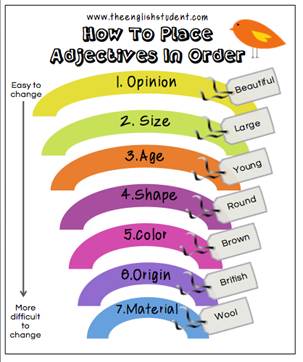
By providing exemplars and image-based support as shown above, I can accommodate for students with visual learning styles, dyslexia, and students with non-native origins by having extra support beyond simply telling them (Long, et al. 2007; McConlogue 2020). This alternative presentation mode can assist students internalize and have a tangible structure for what could otherwise be less-than-clear.
After that explicit presentation, I could put images on the board and have a playful, but scholastically applicable practice with descriptions around whatever the image may be of, may it be a small, Belgian waffle, covered with delicious, amber syrup and imported walnuts or whatever. The creativity of the playful randomness adds to the openness of possibilities, engaging the students through a bit of silliness, but nonetheless, staying on point with the particular lesson at hand. This would be the controlled practice.
For a freer practice, and a summarizing assessment to track their overall learning, a collection of photographic or illustrated images that are busy, such as images of a park or at a train station, could be handed out or projected so the students could stretch their learning in a way that would allow them to be as creative as they choose from the variety provided in such an image. Assessing that practice would come from collecting their results and attending to those results after class, in reflection, measuring their product against a prepared rubric to assign a resultant score to go along with what actionable feedback I can provide in that setting.
Citations
Carter, Ronald; McCarthy, Michael. (2006). Cambridge Grammar of English, A Comprehensive Guide, Spoken and Written English Grammar Usage. Cambridge University Press. Cambridge, New York, Melbourne, Madrid, Cape Town, Singapore, Sao Paulo.
Chandrasekar, Mira Saraswathi; Ramachandran, A. (2017). Diagramming Complex Sentences: A visual Approach to English Grammar (sic). Vijaya Online Academy, India.
Gardener, Howard. (2024) The Essential Howard Gardener. Teachers College Press, Columbia University, New York.
Hall, Diane. (2016). English for Everyone, English Grammar Guide. Penguin Random House, DK Publishing. New York.
Hancock, Mark. (1998). Singing Grammar, Teaching grammar through songs. Cambridge University Press. Cambridge, New York Melbourne, Madrid
Jones Ed.D, Darolyn (2021) Barron’s Painless Reading Comprehension. 4th Ed. Kaplan Inc. New York
Kennedy, B. L. (1993). Non-native Speakers as Students in First-year Composition Classes with Native Speakers: How can Writing Tutors Help? The Writing Center Journal, 13(2), 27–38. http://www.jstor.org/stable/43441928 Accessed June 2024.
Larsen-Freeman, Diane (2009). Teaching and testing grammar. In M. Long and C. Doughty (Eds.) The Handbook of Language Teaching (pp. 518-542). Malden, MA: Blackwell. https://www.docdroid.net/NoGggnj/approaches-language-structure-teaching-and-testing-grammar-pdf. Accessed June 2024.
Levin, James; Levin, Sandra R.; Waddoups, Gregory. (1999). Multiplicity in learning and teaching, A framework for developing innovative online learning. Journal of Research on Computing in Education, 32(2), 256-269. https://pages.ucsd.edu/~jalevin/LLW-multiplicity.htm. Accessed June 2024.
Long, L., MacBlain, S., & MacBlain, M. (2007). Supporting students with dyslexia at the secondary level: An emotional model of literacy. Journal of Adolescent & Adult Literacy, 51(2), 124–134. https://doi.org/10.1598/jaal.51.2.4. Accessed June 2024.
McConlogue, T. (2020). Developing Inclusive Curriculum and Assessment Practices. In Assessment and Feedback in Higher Education: A Guide for Teachers (pp. 137–150). UCL Press. https://doi.org/10.2307/j.ctv13xprqb.14 Accessed June 2024.
McLaren, J. (2009). African Diaspora Vernacular Traditions and the Dilemma of Identity. Research in African Literatures, 40(1), 97–111. http://www.jstor.org/stable/30131189 Accessed June 2024
Ontario School Districts (n.d.). Think Literacy, Cross Curricular Approaches Grades 7-12. Government of Ontario, Canada
Oxford Editorial Team (2012). World Explorers Evaluation Booklet. Illustrations by Simon Smith. Oxford University Press. UK
The English Student (2016). Adjective Order. Professional academic, hosted blog. http://www.theenglishstudent.com/ Accessed 2018.